
Confluence Cloud
How to find broken links in Confluence Cloud
For a small set of Confluence Cloud pages, open each link as an intended reader, correct the destination, and check the published change. For a recurring space-wide review, use a scanner to collect results, then investigate missing content and access problems separately.
Follow the manual steps below, keep a record in the downloadable CSV register, and use the worked example to check your result. The manual workflow needs no app.
Choose the pages that matter first
Start with a specific group of pages: the onboarding pages new colleagues follow, the support articles agents send to customers, or the runbooks used during an incident. Record which pages you reviewed so that “no problems found” has a clear scope.
Check the links that readers actually follow. Include linked text, buttons, Smart Links, attachments and links to headings where they appear. A page can open successfully while an attachment is unavailable or a heading link lands in the wrong place.
Confluence has a specific native view for undefined placeholder pages: open the space’s More actions → Space settings → Content → Undefined. Atlassian describes these as links to pages that have not been published yet. Use it for that problem; it does not establish that external websites or all existing destinations work. See Atlassian’s explanation of undefined links.
Review and fix a small set manually
1. Open the destination as an intended reader
Open a link from the published source page using the account and access conditions your readers normally have. An administrator may be able to open content that a support agent or customer cannot.
Check both the address and the content. If Invoice upload requirements opens a generic homepage, the link has failed its purpose even if the website loads. If it leads to a heading, confirm that the browser reaches the right section.
When a destination reports a problem, record the message before changing anything. A sign-in prompt or access restriction needs a different next action from an obsolete public URL.
2. Record the source, result and next action
Record each destination together with the page it appears on. If the same URL appears on several pages, give each page its own row so you can track its owner and correction.
Scroll the table horizontally to see all columns.
| Source page and link | What you found | Responsible team | Next action |
|---|---|---|---|
| Invoice upload troubleshooting → Invoice upload requirements | The old address does not contain the requirements; the checker reports HTTP 404 | Knowledge owner | Find the current instructions, replace the source link and recheck |
| Invoice upload troubleshooting → Billing portal access | Authentication or permission needs investigation | Billing service owner | Check access with an intended user before deciding whether the URL is wrong |
| Invoice upload troubleshooting → Documentation homepage | The expected destination opens | Knowledge owner | Record the check date; no correction needed |
Keep a record of the review. Download a blank register or a filled example with synthetic data. Both CSV files include the source URL, destination, owner, next action, replacement and recheck outcome. You can also create the same columns in a Confluence table.
A useful next action names what must happen: “replace the obsolete upload instructions” or “ask the space administrator to check inherited access.” “Broken” alone leaves the next reviewer to repeat the investigation.
3. Edit the source link and publish the change
Find the replacement first. Open it and confirm that it answers the same question as the old destination. If you cannot edit the source page, send the owner the old URL, the replacement and where the link appears.
For a normal text link in the Cloud editor:
- Open the source page and select Edit.
- Select the link, then Edit link in its floating toolbar.
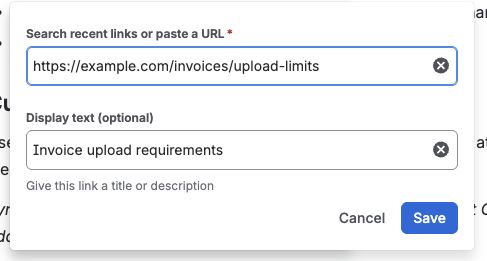
- Enter the replacement URL in Search recent links or paste a URL. Check Display text as well: it should describe the destination.
- Select Save in the link dialog, then Update on the page.
- Open the link again from the published page. Saving the link dialog alone does not publish the page change.
For a replacement section within a Confluence page, use the link icon beside its heading to copy the section URL. This avoids guessing the anchor. Atlassian documents this in Insert links and anchors.
If you only maintain a handful of pages occasionally, this process and the register may be enough.
Separate missing content from access problems
A failed check can mean missing content, restricted access or a temporary problem. Identify the cause before replacing or removing the link.
Open the link as an intended reader
Public URL · 404 / 410
Missing content
Check the address and ask the content owner for the current destination.
Verify a replacement
Sign-in · 401 / 403
Access needed
Check the intended account, permissions and possible blocking of automated requests.
Investigate access
Timeout · rate limit · 5xx
Temporary failure
Record the result and retry later. An incomplete check does not establish availability.
Recheck later
If the link opens: confirm that it reaches the right instructions and heading.
Scroll the table horizontally to see all columns.
| Observation | What the result means | Next step |
|---|---|---|
| A public destination returns 404 or 410 | The requested resource was not found or is reported gone | Check for a typo, replacement or retirement with the content owner |
| Sign-in is required, or the server returns 401 or 403 | This request did not get authorized access | Open it with the intended account; investigate access or automated-request blocking |
| A Confluence page is unavailable to a reader | That reader cannot reach it; the page may still exist | Check the page, its parents and the space permissions with an authorized owner or administrator |
| Timeout, rate limit or temporary server error | The check could not confirm whether the destination works | Record the failure and retry later; avoid repeated immediate checks |
| A page loads but contains the wrong instructions, or a heading link misses its section | The link opens, but it does not take the reader to the right information | Correct the destination or link text, then check the reader’s path again |
Confluence access can depend on the content item, its parents and the space. If someone should have access, investigate the relevant level with someone authorized to manage it. See Troubleshoot access problems to content.
Do not change a correctly restricted page’s URL just to make an automated result look successful. Keep an access investigation open until you know what the intended reader should be able to see.
Use a scanner when the manual review becomes repetitive
A scanner becomes useful when you keep revisiting the same space, need an inventory of affected source pages, or need several owners to work through results. Before choosing one, check:
- Coverage: published pages, blog posts, attachments, Smart Links, plain-text URLs and content inside macros can have different support.
- Access: which identity performs a check, and what happens when a page or destination is restricted.
- Completion: whether a scan finished, hit a limit or excluded destinations. Check how much content was scanned, even if the filtered results show no problems.
- Follow-through: whether you can find the source page, identify responsibility and recheck after editing.
Two alternatives to investigate are Broken Links+ for Confluence, whose listing describes checks across pages, blogs and several destination types, and Link Management, whose listing describes link detection and bulk editing. These are listing-based examples, not results of a side-by-side product test.
A scanner-assisted example with Link Steward
Link Steward groups results by the current Confluence page owner and tracks the link check separately from the progress of the correction. I build this app. The example below uses a development installation with synthetic pages and URLs. See the product page for installation availability.
- The test space already allowed the exact public hostnames used by the example. External checks need these rules; internal Confluence links do not need an external-domain rule.
- We opened the published page’s More actions → Apps → Link Steward for Confluence (Development) and selected Check this page.
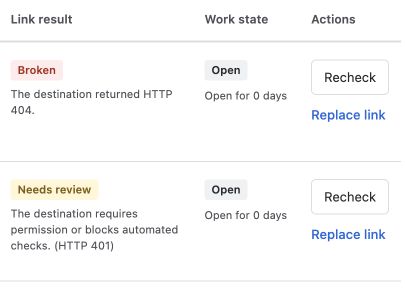
- After refreshing the completed results, the obsolete external URL was Broken with HTTP 404. A synthetic HTTP 401 endpoint was Needs review. The working homepage was Available.
- We used the broken result to identify the correction, then changed the URL through Confluence’s native link editor.
The before-and-after screenshots below show which result changed and which still needed review.
For a whole-space review, use Scan space, inspect the completion and coverage messages, and separate Broken from Needs review. My queue follows the current Confluence page owner; changing responsibility requires changing that owner in Confluence. Use a separate team register if the person doing the correction differs from the page owner.
Link Steward checks supported links in published page content. It does not scan plain-text URLs or content inside third-party macros. Its HTTP checks do not verify the meaning of a destination or whether an anchor identifies the intended section. Keep those manual checks in your process.
Recheck before closing the work
After updating a source page, open its corrected link as an intended reader. If you used a scanner, rerun its page check and confirm that the result has a new checked timestamp.
In our example, replacing the obsolete URL removed that destination from the source. The completed recheck recorded the old link as Link removed / Resolved and the new internal destination as Available. The separate 401 result still needed investigation, so the review stayed open.
One correction, checked
What changed after the edit?
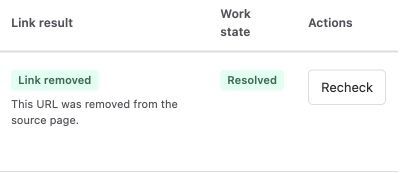
In Link Steward, a link that already worked is No issue. Count it separately from corrected links in your register.
Keep the reviewed page list, who was responsible, the correction and the recheck date. Repeat the review when a documentation system changes, important instructions are retired, or your team’s review interval comes due.
For recurring checks across a space, see how Link Steward groups link issues by page owner. Its user guide covers settings, coverage limits and rechecking.
About this example. Tested in Confluence Cloud on 14 September 2026 with synthetic content and Link Steward development major version 5. Screenshots and observations describe that installation; the production release was not tested in this walkthrough. Confluence access restrictions are explained from Atlassian documentation; they were not tested with two accounts here.